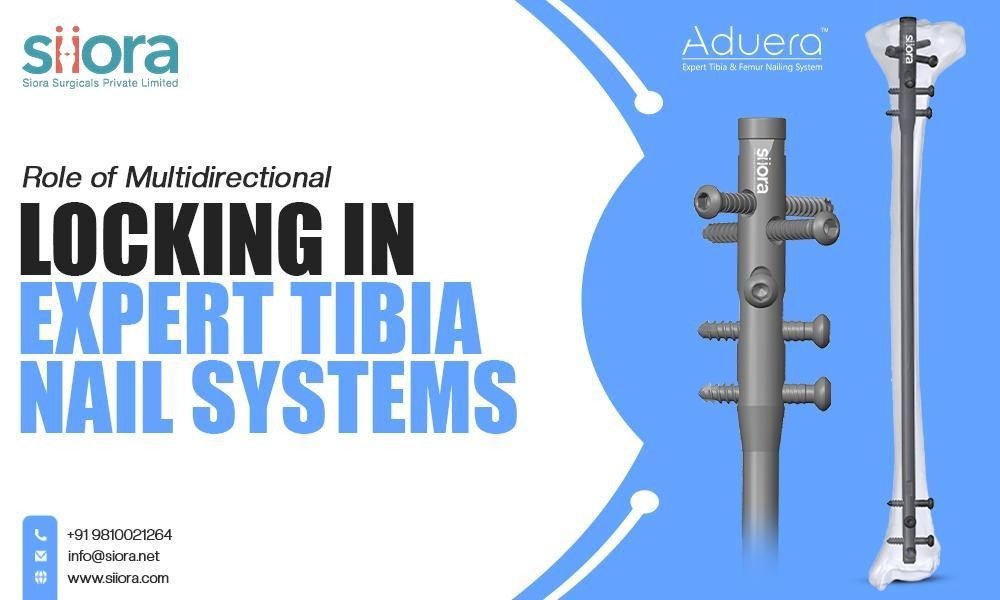
Role of Multidirectional Locking in Expert Tibia Nail Systems

Fixing tibial fractures isn’t always straightforward. The bone takes on heavy mechanical loads and sits close to the skin, leaving little margin for error. Over time, surgeons have moved from basic rods and plates to more refined systems like the Expert Tibia Nail (ETN). What really sets this system apart is its multidirectional locking feature, a design tweak that has turned complex tibial repairs into far more controlled and predictable procedures.
Why the Tibia Demands Smarter Fixation?
The tibia is the main weight-bearing bone of the lower leg, and when it breaks—from road injuries, sports trauma, or falls—the consequences can be long-term. Earlier fixation devices could hold fractures together, but alignment problems, delayed union, and implant failures were frequent, especially in fractures near the knee or ankle.
The ETN was designed to solve those issues with a low-profile, load-sharing intramedullary nail that could handle everything from clean midshaft breaks to messy, multi-fragment injuries. The multidirectional locking screw system is what gives it the precision surgeons need to handle these unpredictable situations.
What Multidirectional Locking Really Does?
Older tibial nail systems limited the screw angle—holes were drilled in just one fixed direction. That often meant surgeons couldn’t hit strong bone or might miss the optimal screw path to stabilize smaller fragments. The multidirectional locking feature changed all that.
Each screw hole in the ETN is built with a conical or oblong design that allows the surgeon to angle the locking screw within about 10–15 degrees of freedom. Once the screw threads lock into the nail, it forms a rigid, fixed-angle connection—similar stability, but with much more control.
This is particularly helpful when dealing with fractures near the bone ends, where anatomy varies and every millimeter of precision counts.
Better Stability and Load Control
The real beauty of multidirectional locking is in how it spreads and controls stress. Traditional single-plane locking systems could allow micro-movements that led to rotational instability or axial shortening. In contrast, angled screw pathways stabilize the nail across multiple planes, locking down both rotation and length variations.
In clinical settings, this translates to far fewer cases of loss of alignment or secondary shifts, even when patients begin early weight-bearing. The added control also means the bone, not the implant, takes more of the load during healing—reducing the risk of screw loosening or breakage.
Game Changer for Proximal and Distal Fractures
Fractures at the top and bottom of the tibia are always the toughest to fix. The ETN’s multidirectional screw pattern gives surgeons an edge here. In distal fractures, angled locking lets screws anchor into denser bone areas while avoiding the ankle joint. In proximal cases, screws can be aimed into the subchondral regions just below the knee joint, giving superior hold where traditional holes might miss.
This means better fixation strength and alignment in fractures that once relied on cumbersome plates or long healing times. Patients walk sooner and face significantly fewer long-term deformities like varus or valgus tilt.
See also: Transforming Manufacturing with Advanced Casting Techniques
How Does It Help Patients Heal Faster?
Because the ETN’s design requires smaller incisions and less soft-tissue disruption, patients typically experience less pain and faster recovery compared to older plate-based surgeries. The multidirectional locking contributes by giving immediate mechanical stability, which supports early mobilization and faster callus formation.
Surgeons frequently report union rates above 95%, with most patients regaining normal walking ability within three to four months—remarkable for a weight-bearing bone with such high stress demands.
A Small Detail, Big Impact
By allowing variable angle screw to lock from different angles while maintaining rigid stability, multidirectional locking has quietly revolutionized tibial fracture care. It’s proof that sometimes the smallest design changes can make the biggest difference.
The Expert Tibia Nail’s system doesn’t just fix broken bones—it restores balance, mobility, and quality of life with fewer complications and better long-term results. For many surgeons, it has become the go-to solution when precision and reliability matter most.